

Areca Plates Market Projected to Reach $2.08 Billion by 2035 as Global Plastic Bans Create a Permanent Demand Floor
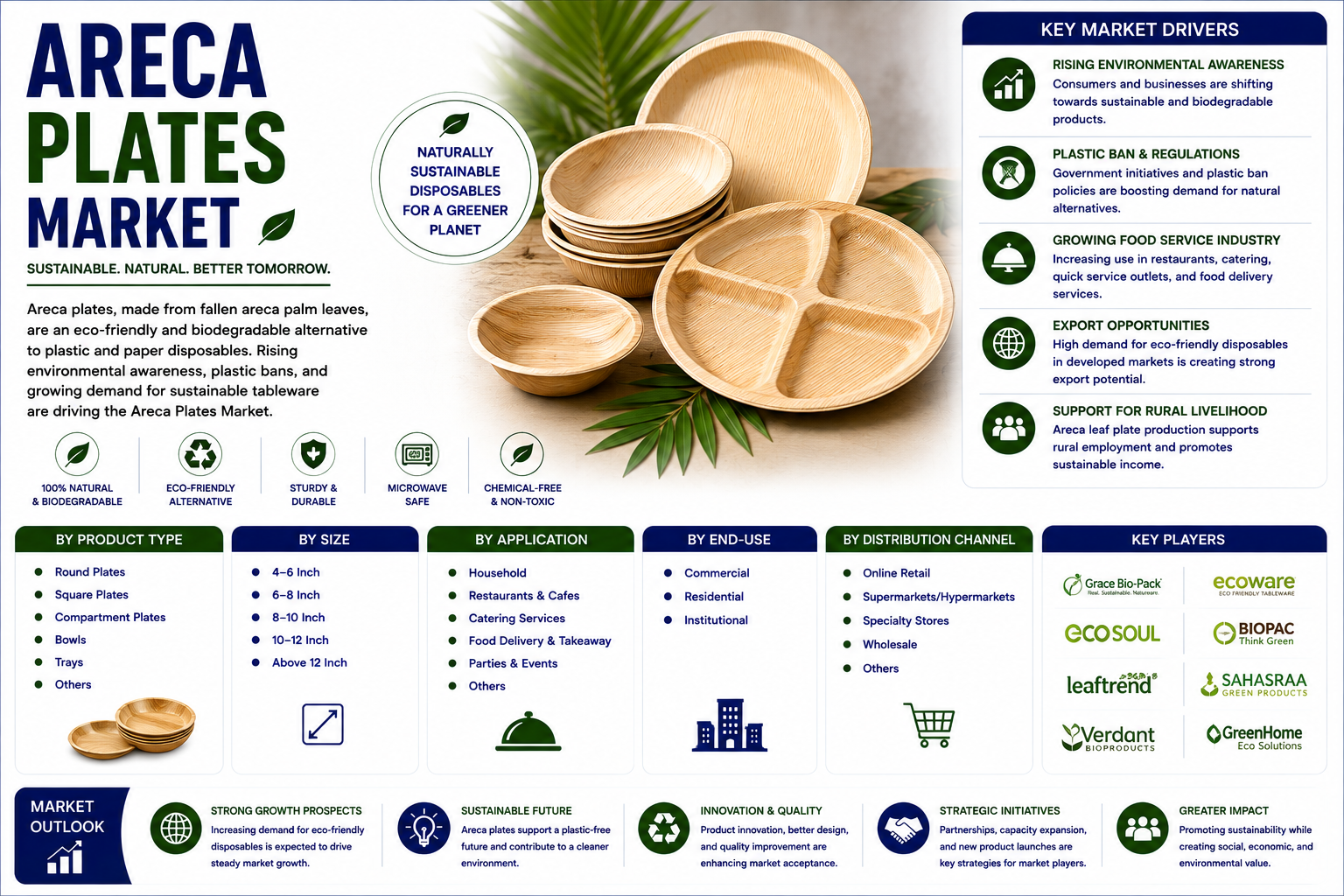
Areca Plates Market (2026 - 2035)
The MEA is projected to expand at a 6.6% CAGR, led by hospitality-sector green mandates in the UAE and sustainable tourism initiatives in East Africa.
GA, UNITED STATES, August 21, 2026 /EINPresswire.com/ -- The global areca plates market is riding a wave of regulatory transformation that has turned a traditional rural craft into a fast-scaling international industry. Valued at an estimated $1.27 billion in 2025, the market is projected to grow from $1.34 billion in 2026 to approximately $2.08 billion by 2035, registering a compound annual growth rate of 5.0%. This expansion is anchored in tightening single-use plastic bans across the European Union, India, and Southeast Asia, coupled with rising institutional procurement of compostable tableware by global hospitality chains, airlines, and railway operators.From Rural Craft to Industrial Commodity
The areca plate industry is undergoing a silent revolution in manufacturing technology. Up until 2022, production was dominated by sun-drying and manual pressing, which limited consistency and scale. That is changing rapidly with the introduction of semi-automated hydraulic press equipment capable of producing 800 to 1,200 plates per hour. This modernization cycle has been fast-tracked by state-level subsidies in Karnataka and Kerala, where government programs provide capital subsidies of up to INR 35 lakh, approximately $42,000, for leaf-plate manufacturing units. The outcome is more consistent plate thickness and heat resistance, opening up food-service contracts that previously defaulted to bagasse or polylactic acid alternatives.
India's Plastic Waste Management Amendment Rules, broadened in 2024, created an immediate demand floor for biodegradable alternatives by prohibiting the manufacture, import, stocking, distribution, and sale of several disposable plastic and thermocol items including plates, cups, and cutlery. This regulatory tailwind is not limited to India. The EU's Single-Use Plastics Directive and comparable frameworks in North America have accelerated interest in Indian-origin areca tableware, particularly in Germany and the Nordic region.
Market Size and Forecast Trajectory
Market Research Future's estimates employ a triangulated research technique that incorporates bottom-up capacity evaluation of major areca-growing states including Karnataka, Kerala, and Assam, trade flow data from UN Comtrade, and top-down demand estimation from food-service packaging usage. Historical estimates from 2021 through 2024 are based on customs data and industry association disclosures. The market has grown from $1.09 billion in 2021 and is expected to reach $1.48 billion by 2028 before climbing toward the $2.08 billion endpoint in 2035.
Segment Analysis by Product Type
Round plates command the largest share of the areca plates market, capturing approximately 41% of global revenue in 2025. Their dominance reflects universal compatibility with food-service portioning standards across quick-service restaurants, hotel buffets, and street-food service. Diameters ranging from 6 to 12 inches cover the full spectrum from appetizer to entrée plating, and their compatibility with existing food-service logistics makes them the default specification in bulk procurement.
Square and rectangular plates generated approximately $0.31 billion in 2025, catering to premium catering applications where presentation aesthetics differentiate the offering. Bowls represent the fastest-growing product sub-segment, projected to expand at a 6.3% CAGR through 2035. This acceleration is driven by the expansion of soup-and-salad fast-casual chains and the meal-delivery sector's need for leak-resistant biodegradable containers. Trays and compartment plates, valued at approximately $0.14 billion, are finding rapid uptake in institutional channels, particularly Indian Railways and airline catering, where partitioned serving reduces the need for multiple containers per meal.
Request Free Sample Copy: https://www.marketresearchfuture.com/sample_request/31694
Segment Analysis by Application
Food service is the revenue backbone of the areca plates market, generating approximately $0.58 billion in 2025. This segment is anchored by institutional procurement from hotel chains, restaurants, and cloud kitchens implementing plastic-free policies. Contract sizes typically range from 50,000 to 500,000 plates per quarter, providing manufacturers with production planning stability. Major global hospitality groups including IHG, Marriott, and Accor have implemented ambitious sustainability policies that have evolved into institutional procurement contracts, giving manufacturers more stable, long-term revenue visibility.
Events and weddings represent the highest per-unit margin application and the fastest-growing segment overall, expanding at a 6.8% CAGR. In India alone, the wedding industry is valued at over $50 billion, and a growing segment of eco-conscious consumers now actively seeks biodegradable tableware as part of sustainable event planning. Custom-embossed areca plates with logos or decorative patterns can command 30 to 40% price premiums over standard variants, transforming a commodity product into a branded lifestyle item.
Retail consumer demand is growing at a 5.6% CAGR, fueled by e-commerce platforms and zero-waste lifestyle adoption. Institutional catering captured roughly 22% of market share, serving railways, airlines, and government canteens where large-volume, short-duration demand for sustainable disposables is concentrated.
Segment Analysis by Distribution Channel
Business-to-business direct sales dominate the distribution landscape, accounting for approximately 58% of market revenue in 2025. This reflects the bulk-procurement nature of food-service and institutional demand, where manufacturers sell directly to hotel chains, caterers, and export distributors. Online retail is the fastest-growing channel, projected to expand at a 7.2% CAGR. Cross-border e-commerce in areca plates grew at approximately 12% annually between 2022 and 2025, with Amazon, Etsy, and specialized zero-waste marketplaces opening direct export channels for small and mid-sized Indian processors. Bypassing traditional distribution intermediaries improves manufacturer margins by 15 to 20%. Offline retail, encompassing supermarkets and specialty stores, contributed approximately $0.19 billion.
Regional Landscape: Asia-Pacific Dominates, Middle East and Africa Surges
Asia-Pacific overwhelmingly dominates the global areca plates market with approximately 82% of revenue in 2025. India is the undisputed center of gravity, accounting for the vast majority of global production, consumption, and exports. Karnataka state alone operates over 2,500 registered plate-pressing units. Domestic demand surged following the July 2022 single-use plastic ban, and government programs like the Prime Minister Formalisation of Micro Food Processing Enterprises provide credit-linked subsidies that lower barriers for rural entrepreneurs. The Indian government's support for food-processing infrastructure, including hydraulic press equipment and drying machinery, has been instrumental in scaling output.
China contributed approximately $0.03 billion, driven by government plastic restrictions and eco-packaging mandates. Japan is growing at a 4.8% CAGR, supported by premium packaging culture and sustainability branding. South Korea contributed approximately $0.008 billion. The ASEAN bloc is expanding at a 5.6% CAGR, with Indonesia and Myanmar emerging as alternative sourcing origins, though their processing infrastructure trails India by an estimated five to seven years. The rest of Asia-Pacific, including Nepal, Bangladesh, and Sri Lanka, contributed approximately $0.012 billion.
Europe holds the second-largest share outside Asia, generating approximately $0.08 billion in 2025. Germany leads European imports, with retailers like dm-drogerie markt and REWE stocking branded leaf-plate products in sustainability aisles. The United Kingdom is growing at a 4.9% CAGR through post-Brexit packaging reform and extended producer responsibility obligations. France contributed approximately $0.011 billion, propelled by the Anti-Waste and Circular Economy Law. Italy is expanding at a 4.5% CAGR through Mediterranean tourism and event catering. Spain contributed approximately $0.006 billion. The Nordic countries are growing at a 5.4% CAGR, with municipal green procurement policies creating guaranteed demand floors. Russia captured roughly $0.002 billion through niche organic retailers. The rest of Europe is expanding at a 4.1% CAGR as regulatory alignment with EU directives progresses.
North America is projected to grow at a 5.8% CAGR through 2035. The United States accounts for approximately 68% of regional revenue, driven primarily through Amazon and specialty e-commerce platforms targeting eco-conscious households. Canada's Single-Use Plastics Prohibition Regulations, which banned plastic cutlery and food-service ware effective December 2023, opened direct substitution channels. Mexico contributed approximately $0.005 billion, with early-stage sustainable packaging adoption signaling medium-term potential.
South America was valued at approximately $0.03 billion in 2025, expanding at a 4.2% CAGR. Brazil dominates with roughly 52% of the regional share, supported by the growing middle class and expanding organic-food retail sector. Argentina is growing at a 4.0% CAGR through gradual adoption in urban food service. The rest of South America remains in early-stage import channel development.
Buy Now: https://www.marketresearchfuture.com/checkout?currency=one_user-USD&report_id=31694
The Middle East and Africa is the fastest-growing region, projected to expand at a 6.6% CAGR. The United Arab Emirates is growing at a 7.1% pace, driven by Expo legacy green standards and tourism mandates that require hospitality-sector sustainability commitments. Saudi Arabia contributed approximately $0.006 billion. South Africa is expanding at a 5.8% CAGR through restaurant industry sustainability programs. Kenya, Rwanda, and Tanzania anchor East African demand through some of the world's strictest plastic-ban regimes and eco-tourism procurement that increasingly specifies biodegradable tableware in lodge and safari camp operations. Egypt contributed approximately $0.003 billion. The rest of the region is growing at a 6.9% CAGR as plastic-ban early movers create receptive import conditions.
Competitive Landscape
The areca plates market is severely fragmented, with an estimated Herfindahl-Hirschman Index below 500. The top five producers account for an estimated 18 to 24% of global revenue, with the remainder spread across thousands of micro, small, and medium enterprise-scale firms concentrated in southern India. Competitive differentiation increasingly depends on export compliance certification, automated manufacturing capability, and digital channel integration rather than simply access to raw materials.
The Campco Limited leads with an estimated 4 to 6% revenue share, operating a cooperative model with over 120,000 farmer-members and vertical integration into waste valorization. In September 2025, the company announced construction of an organic manure factory on 18 acres to convert areca husk waste into bio-fertilizer, reinforcing farmer retention and circular economy positioning.
GM Group captures roughly 2 to 4% through multi-product areca processing with Gulf and Southeast Asian export networks. Viet Delta Industrial Company holds approximately 2 to 3% as a Vietnamese origin diversifier offering competitive pricing for Asian markets. PT Ruby Privatindo accounts for roughly 1 to 3% with Indonesian-origin areca plates and bowls, providing Southeast Asian supply diversification.
Swastika International captures approximately 2 to 3% as an India-based exporter with US Food and Drug Administration and EU food-contact compliance. Pappco Greenware holds roughly 2 to 4% through premium branded leaf plates, bowls, and trays with strong Amazon and retail presence in India and the United States. Holy City Straw Company accounts for approximately 1 to 2% through US-based distribution focused on retail and food-service sustainability. Leaf Republic GmbH captures roughly 1 to 2% with a German design-led approach and patented multi-layer leaf technology. EcoFacts holds approximately 1 to 2% as a South Indian manufacturer with laser-engraving and branding capabilities. Natural Panaa rounds out the competitive set with roughly 1 to 2% through full-range areca tableware carrying EU organic and British Retail Consortium certification for premium export channels.
Report Summary: https://www.marketresearchfuture.com/reports/areca-plates-market-31694
Related Report
Returnable Packaging Market https://www.marketresearchfuture.com/reports/returnable-packaging-market-6893
Paper Bags Packaging Market https://www.marketresearchfuture.com/reports/paper-bags-packaging-market-2039
Packaging Market https://www.marketresearchfuture.com/reports/packaging-market-10902
primary packaging market https://www.marketresearchfuture.com/reports/primary-packaging-market-38912
end of line packaging market https://www.marketresearchfuture.com/reports/end-of-line-packaging-market-36968
Market Research Future
Market Research Future
+1 855-661-4441
email us here
Legal Disclaimer:
EIN Presswire provides this news content "as is" without warranty of any kind. We do not accept any responsibility or liability for the accuracy, content, images, videos, licenses, completeness, legality, or reliability of the information contained in this article. If you have any complaints or copyright issues related to this article, kindly contact the author above.
